UMass Disease Modeling Lab
Disease Modeling Lab, PI: Chaitra Gopalappa
PEOPLE | RESEARCH PROJECTS | DECISION TOOLS | PUBLICATIONS | AWARDS/FUNDING
DECISION TOOLS AND MODEL CODE
Interactive dashboards and open-source simulation models developed by the lab. Corresponding publications are HERE and research projects are HERE.
LymeSentinel dashboard
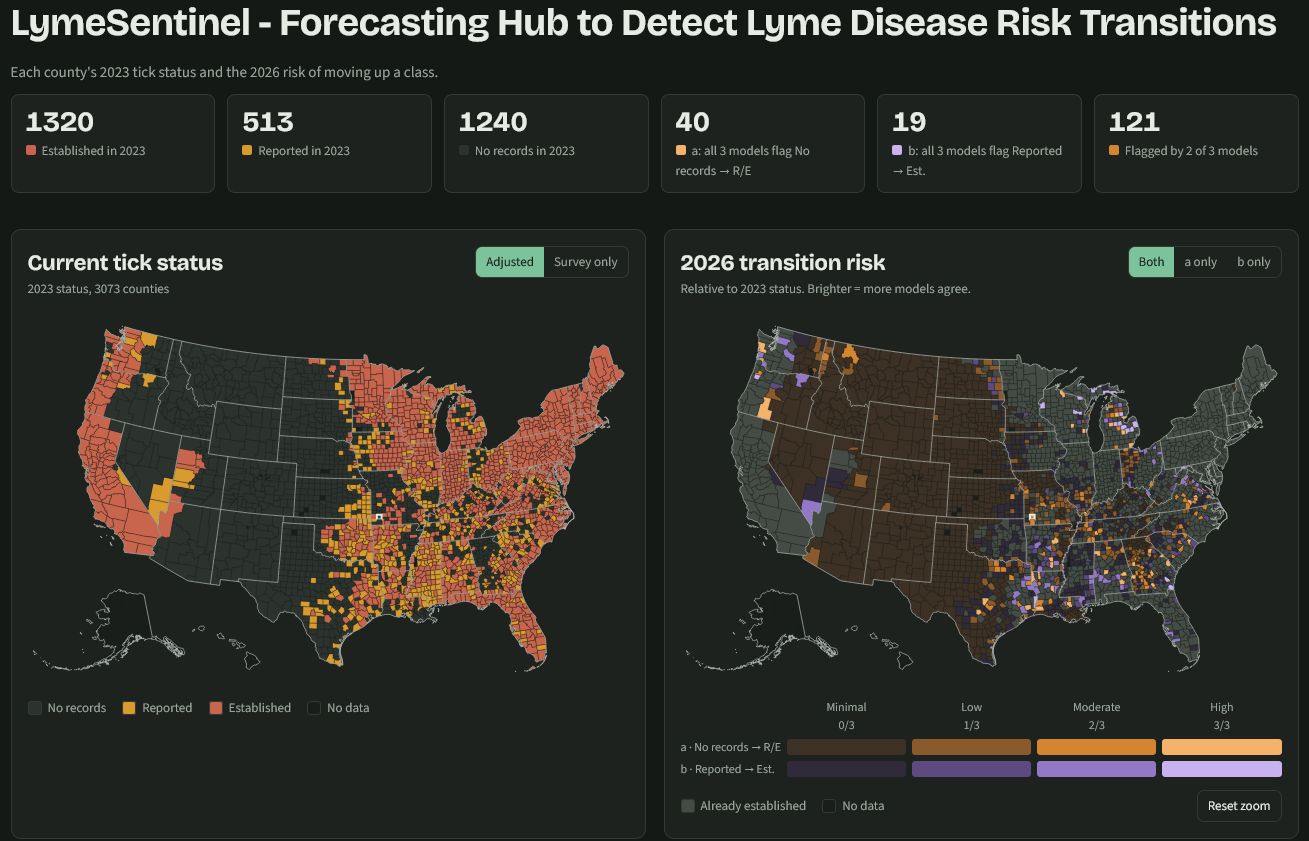
LymeSentinel is a tick and Lyme disease surveillance dashboard. It was a Phase 1 winner of the TOPx HHS Tech Sprint for AI and Invisible Illness, which focuses on using data and AI to make invisible illnesses more visible.
COVID-19 simulation: interactive tool for analyses of phased reopening decisions (v1)
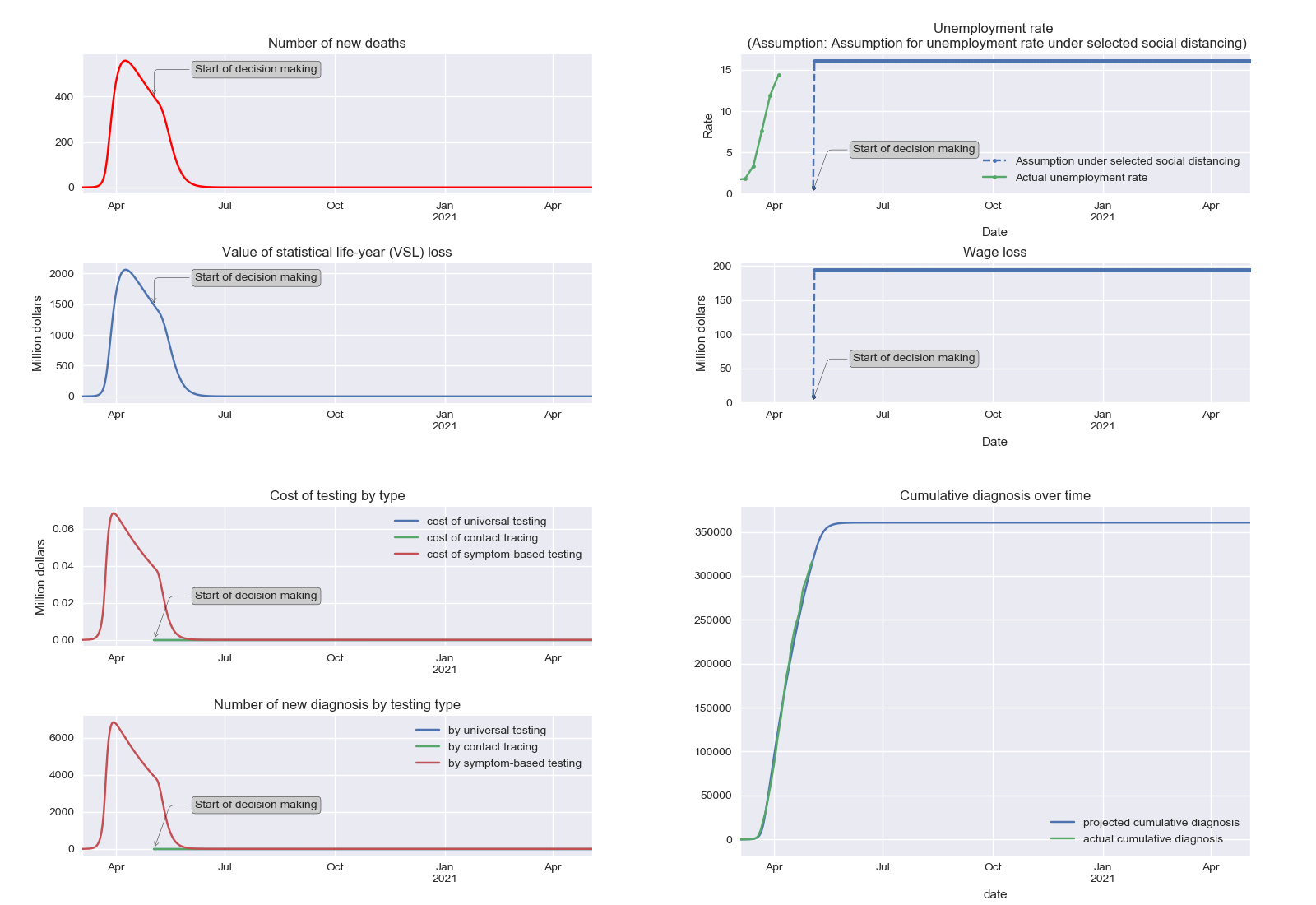
A simulation tool for evaluating phased reopening decisions during COVID-19, applied to the State of New York. Users enter weekly decisions on social distancing, contact tracing and testing, and universal testing over a 52-week period, and the tool projects deaths, diagnoses, hospitalizations, testing costs, and economic losses. It runs in Google Colab in the browser, so no software installation is needed (a Google account is required).
| Open the tool | Model code (GitHub) |
COVID-19 simulation: interactive tool for analyses of phased reopening decisions (v2)
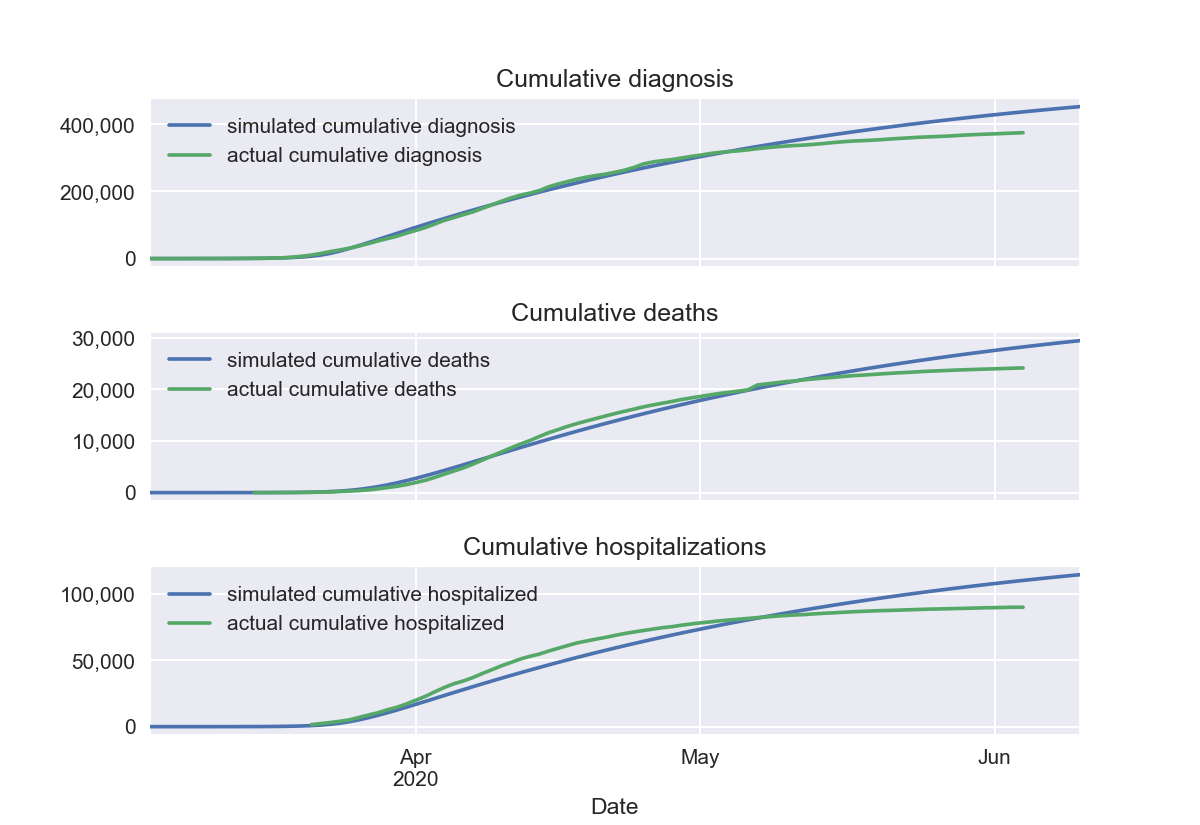
Version 2 of the phased-reopening tool for New York. It models combinations of social distancing, contact tracing and testing, and universal testing, and lets users compare multiple alternative scenarios, adjust decisions daily, and set custom analysis periods. The sample run compares maximum contact reduction with a phased approach that relaxes social distancing while expanding contact tracing and testing. Like v1, it runs in Google Colab.
| Open the tool | Model code (GitHub) | DOI: 10.5281/zenodo.3902751 |
Multi-agent reinforcement learning (MARL) for multi-jurisdictional public health decision analysis
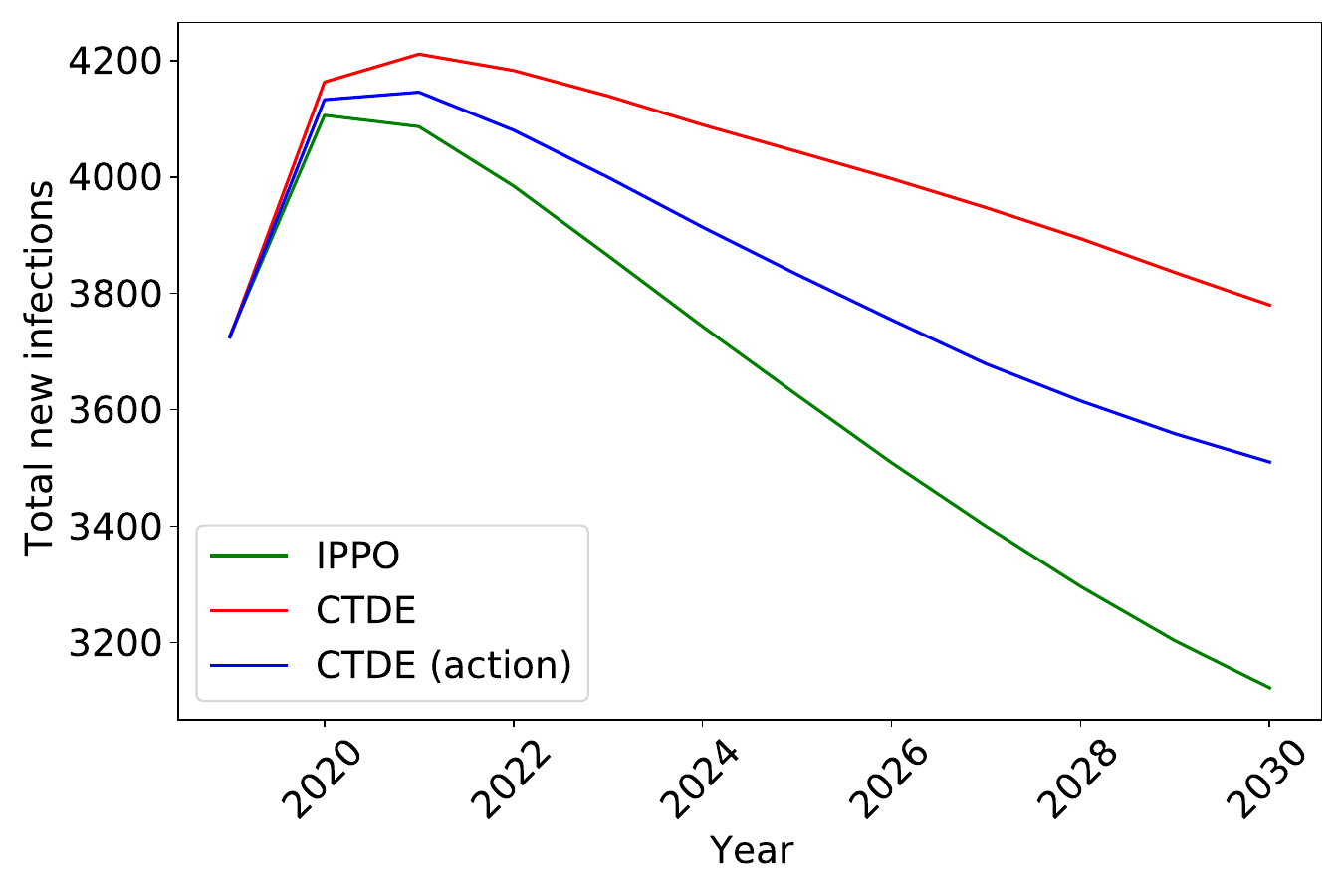
Code for a multi-agent reinforcement learning framework for HIV intervention analysis, in which each jurisdiction is an agent making its own intervention decisions in an epidemic environment with cross-jurisdictional interactions. The repository includes training code for California and Florida using the IPPO, CTDE, and CTDE (action) algorithms, along with result figures.
| Code (GitHub) | Simulator only (GitHub) |
Related publications:
- Sharma, D., Shah, A., & Gopalappa, C. (2025). A multi-agent reinforcement learning framework for public health decision analysis. Healthcare Analytics, 8.
- Tatapudi, H., & Gopalappa, C. (2022). Evaluating the sensitivity of jurisdictional-heterogeneity and jurisdictional-mixing in national-level HIV prevention analyses: Context of the U.S. Ending the HIV Epidemic goal. BMC Medical Research Methodology, 22(1), 304.
Joint model of HIV and HPV
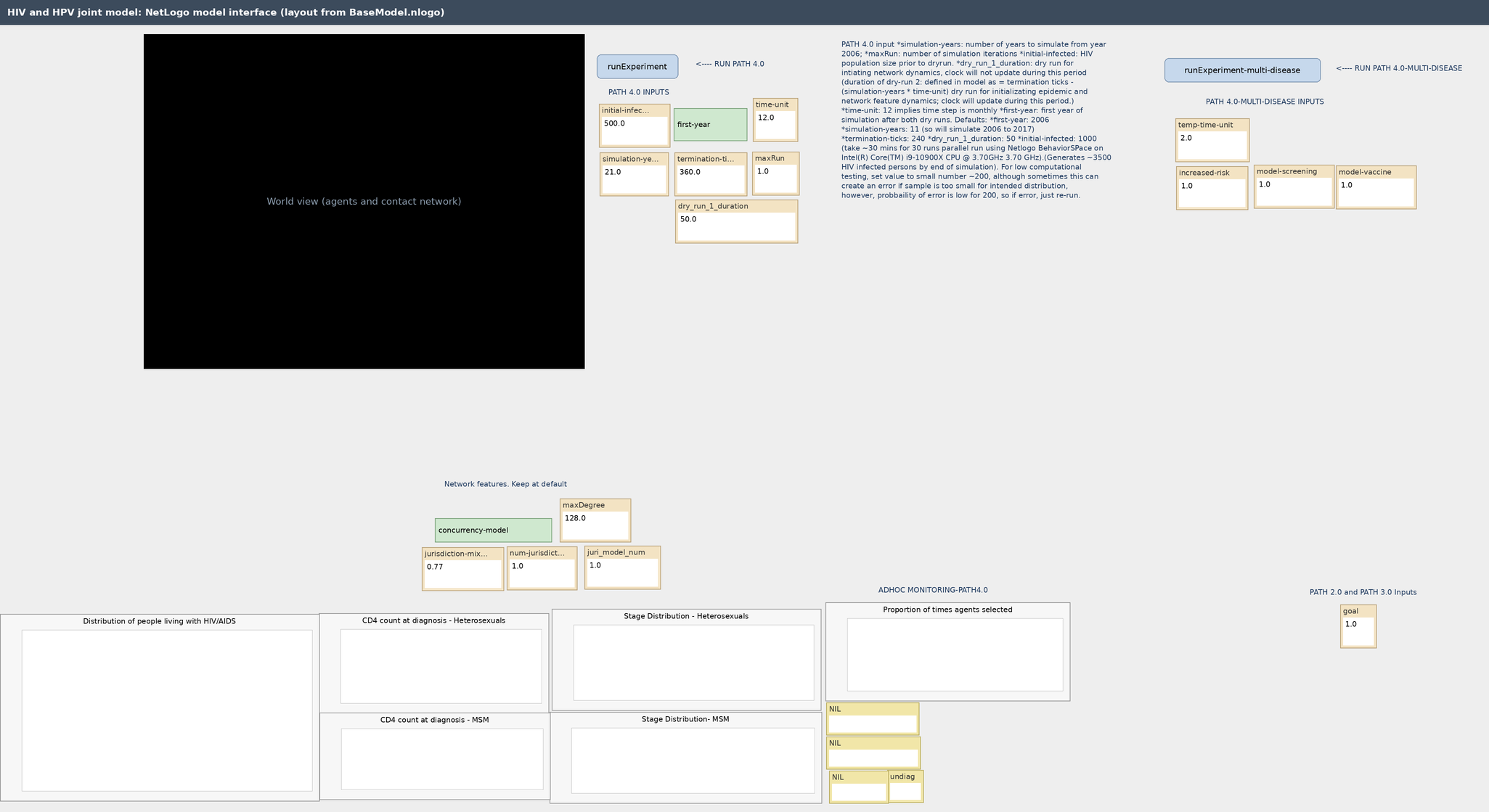
NetLogo model that jointly simulates HIV and HPV using the hybrid agent-based network and compartmental technique. It extends PATH 4.0 with multi-disease inputs, including screening, vaccination, and increased-risk settings, and is run with the runExperiment-multi-disease button.
Related publications:
- Zhao, X., & Gopalappa, C. (2023). Joint modeling HIV and HPV using a new hybrid agent-based network and compartmental simulation technique. PLoS ONE, 18(11), e0288141.
MAC: Mixed agent-based and compartmental model for joint modeling of related infections
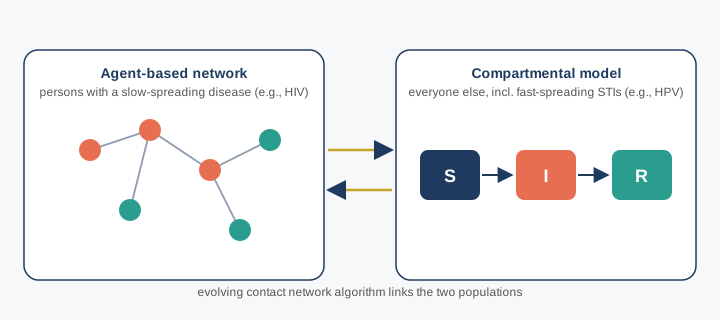
The general framework for joint modeling of related infectious diseases. Persons with at least one slow-spreading disease are simulated in an agent-based network, everyone else (including those with only fast-spreading diseases) in a compartmental model, and an evolving contact network algorithm maintains the contacts between the two populations. Implemented in NetLogo.
Related publications:
- Gopalappa, C., Balasubramanian, H., & Haas, P.J. (2023). A new mixed agent-based network and compartmental simulation framework for joint modeling of related infectious diseases - application to sexually transmitted infections. Infectious Disease Modelling, 8(1), 84-100.
- Zhao, X., & Gopalappa, C. (2023). Joint modeling HIV and HPV using a new hybrid agent-based network and compartmental simulation technique. PLoS ONE, 18(11), e0288141.
PATH 4.0: Progression and Transmission of HIV
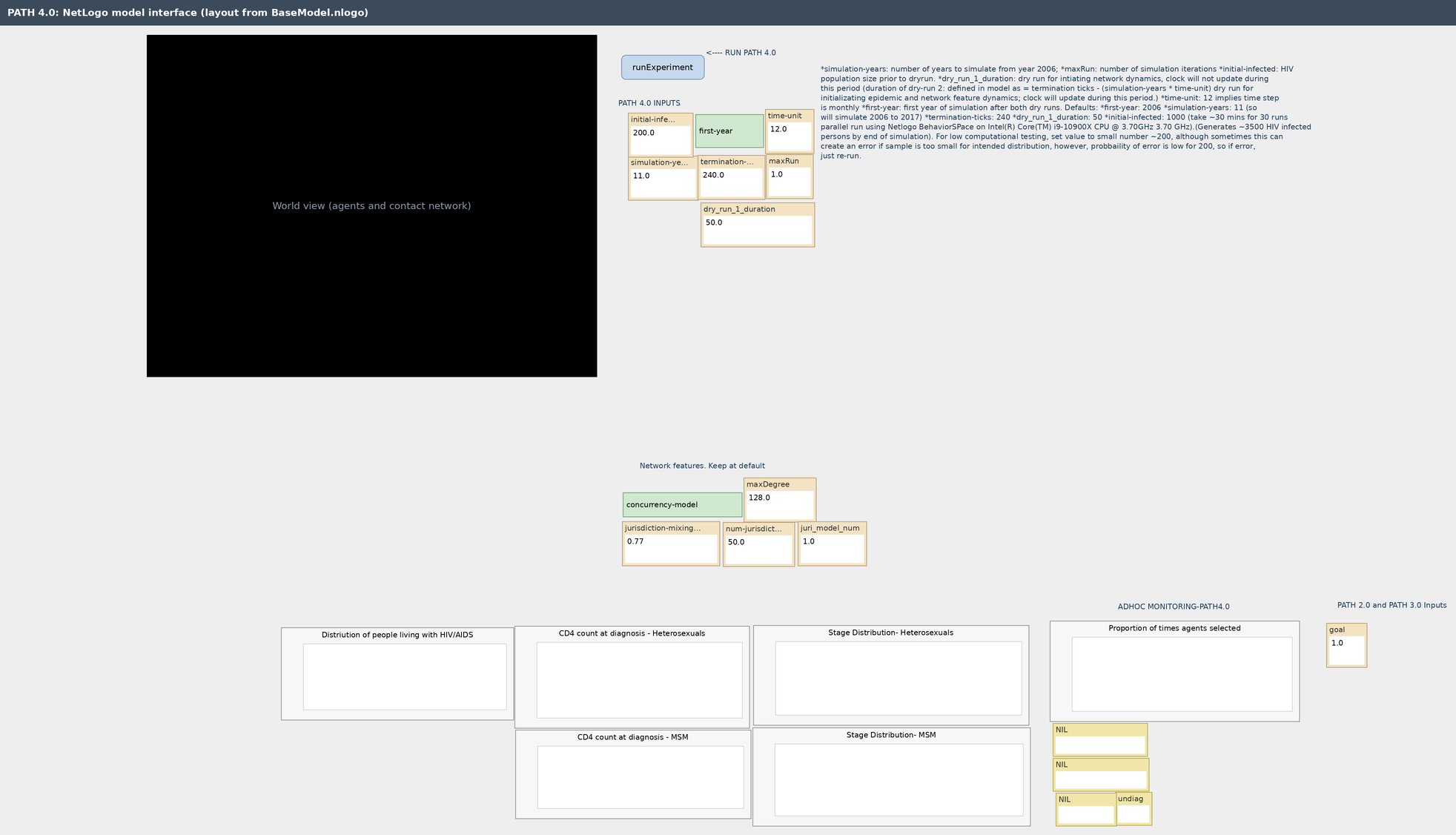
Agent-based evolving network simulation of HIV in the United States, developed in NetLogo 6.2.2 and calibrated to the period 2006 to 2017. Inputs are set on the NetLogo interface (keep the defaults to reproduce the U.S. epidemic for 2006 to 2017), and the model runs with the runExperiment button, writing epidemic features to CSV files. Care-continuum input files can be updated to extend the model past 2017. Intended for academic and research use with in-depth knowledge of PATH methods and NetLogo.
Related publications:
- Singh, S., France, A.M., Chen, Y-H., Farnham, P.G., Oster, A.M., & Gopalappa, C. (2021). Progression and Transmission of HIV (PATH4.0): A new agent-based evolving network simulation for modeling HIV transmission clusters. Mathematical Biosciences and Engineering, 18(3).
- Eden, M., Castonguay, R., Munkbat, B., Balasubramanian, H., & Gopalappa, C. (2021). Agent-based evolving network modeling: a new simulation method for modeling low prevalence infectious diseases. Health Care Management Science, 24, 623–639.
- France, A.M., Panneer, N., Farnham, P.G., Oster, A.M., Viguerie, A., & Gopalappa, C. (2024). Extent and composition of molecular HIV sexual transmission clusters in a nationally representative simulation model indicate intervention opportunities. JAIDS, 95(4), 355-361.